
Carl Cane (played by Ronan Summers) Lurks in Phil’s latest film Helloween
The first time I recall hearing or reading the name Phil Claydon was during the release of his film Lesbian Vampire Killers, a fun crazy film starring James Corden, Paul McGann,MyAnna Buring and Silvia Colloca. Its a fun 2009 film that I do have in my DVD collection and so it was so much fun when I had the chance not only to get the films director Phil Claydon on one of the episode of the FromPage2Screen Movie Podcast but also for Phil to take part in the Spending Time With…articles series of interviews that I love doing. We didnt chat too much about his 2009 film, but instead decided to chat about Phil’s latest film the killer clown movie Helloween which is arriving on Digital in the US and the UK this September as well as receiving a limited series of big screen showings in the US, and a UK bluray arriving in October courtesy of 101 Films. But thats enough from me, lets hand over the rest of the article to my questions, and Phils great answers.
Your first feature film is credited as 2002’s Alone which has in its cast Miriam Margoles, and Rick Wakemen. Both legends in their own right- what was that experience like working with them?
I was 24 when I directed Alone. I’d been introduced to the producer David Ball by a film school friend. David Ball produced some eighties genre classics like Day of the Dead and Creepshow 2. As a horror fan this was great, and I listened to many amazing behind the scenes stories about the production of those films. At the time he was putting together a horror anthology series, and came up with one of the stories for the show. I was working at a theatre box office and a bar, when the opportunity to direct Alone happened. David asked to meet, and told me about a horror film they were trying to make, and wanted younger eyes on the script. He offered me two hundred and fifty pounds to read the script and give my opinion on it. I had to do this in a day and meet again. I read it, wrote up a treatment about what I’d do with it. He read it, agreed with it, went to give me a cheque for the two hundred and fifty, I went to take it, but David pulled it away and said ‘or you can direct it instead?’ About a week later we were in pre-production. Miriam Margolyes and Rick Wakeman were both friends of David’s. Working with Miriam was great. For a young director to have an actor of that talent and experience, who trusted me, listened, and was just fun to be around made it a lovely five days shooting her scenes. We also had the great John Shrapnel, another fantastic actor with amazing screen presence and voice. Although at the start I felt very nervous about directing such experienced actors, I learnt very quickly how to communicate and talk to them, and there was no better film school than directing actors with hefty credits, and Shakespearian theatre training. Rick only had a small cameo, but he’s a genuinely lovely person. Rick was also doing the score for Alone, he’d scored many Ken Russell films and infamous slasher The Burning, so to have him score the film was exciting, and being a lifelong soundtrack collector I was looking forward to his score. However, the music he wrote was interesting but did not quite match the tone of the film we were going for. This was an awkward moment as David was friends with him, and he is a big deal, well known musician. To illustrate my case that the music was not right, I went away and had to compose a few pieces with my editor, Jonathan Rudd and his music technician friend Jim Betteridge. We screened a scene with Rick’s music and then with my music, and David simply said, ‘well it looks like I’ve got a very awkward conversation to have with my friend’. In retrospect and as a film fan, I’d love to remix the film with Wakeman’s score, I think it would just be an interesting watch to understand how music can shift tone and vibe, or bring a different feeling to a film. Or at the very least have his unused score released, like having Jerry Goldsmith and Tangerine Dream’s scores for Legend both existing, and watching the film with both version, it’s fascinating.
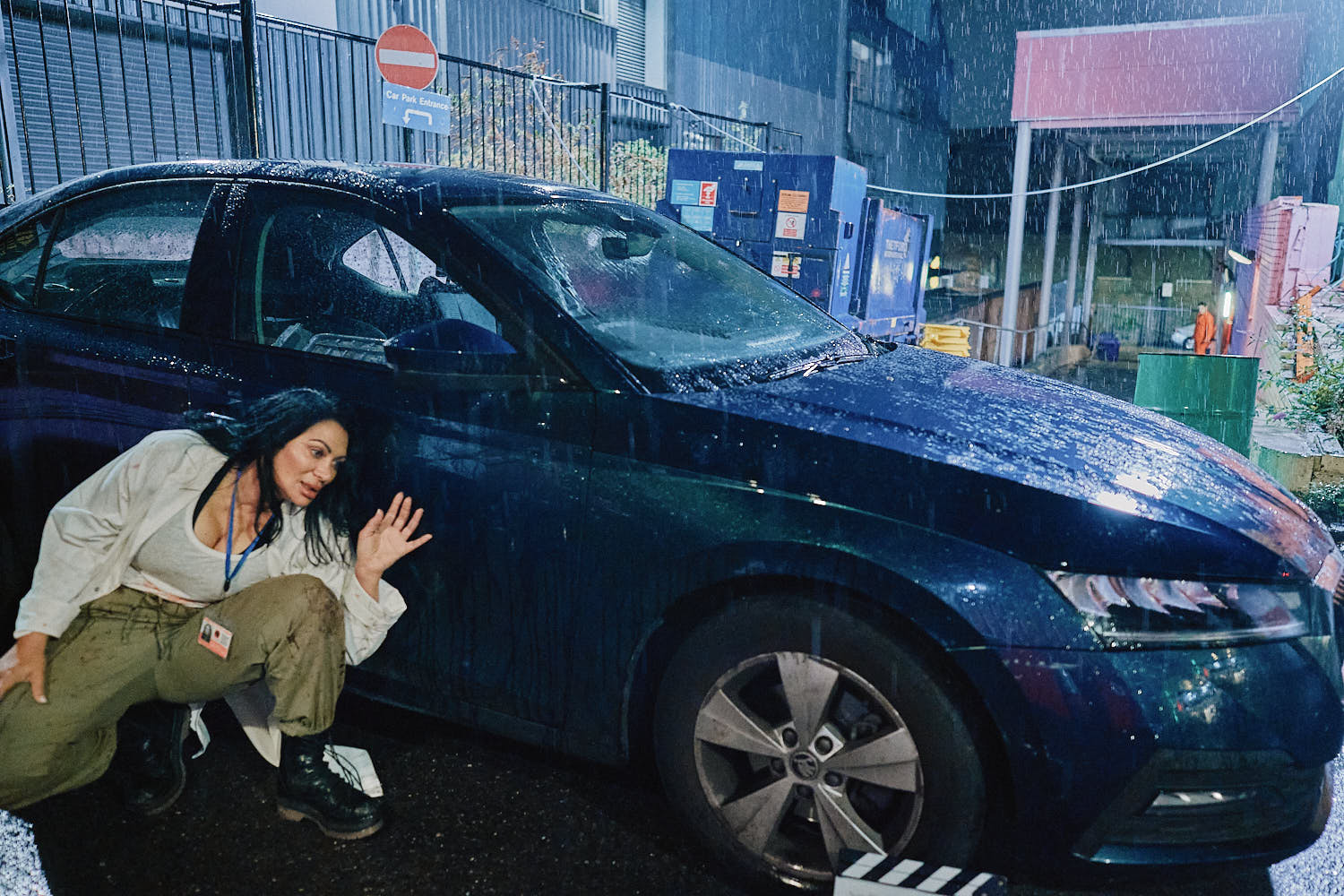
Dr Ellen Marks (played by Jeanine Nerissa Sothcott) is in a race against time again Carl Cane’s reign of terror
I read on your IMDB profile that 1980 was a big year for you in setting your path as a creator, not just because you saw the amazing Star Wars sequel (The Empire Strikes Back) but also because you saw a UFO. What can you tell me about that?
It was a stormy night in 1980, we were driving home from my nanna’s up one of the main A roads. Rain was hammering the windows. I was four, sat in the back of a light blue vauxhall cavalier. I was watching the rain stream against the window, and I saw something extremely bright appear in the sky. It was so unusual I shouted at my parents and brother to look. By the time they turned to see it, the light flashed and vanished. It was weird. The following day my Dad arrives home from work and begins telling us stories about other sightings, I think one of his work colleagues, their car had come to a stop and something was bright in the sky above them. Reports were also in the local news papers, which all validated that I had witnessed something unusual that night. It may have been connected to the 1980 Rendlesham forest incident, which is near that location. One day I want to create a film around that sighting, as I have taken the 2016 clown incidents as a jumping off point for Helloween, so it would be on brand to continue using real life events as the basis for a film. I also want to do one based on the video nasty era as that was a big part of my film education growing up, trying to find a copy of The Texas Chainsaw Massacre, or The Exorcist, as they were banned ridiculously in the UK.
What was the first script/story you ever wrote? And what’s the biggest lesson you took away from the writing process of it?
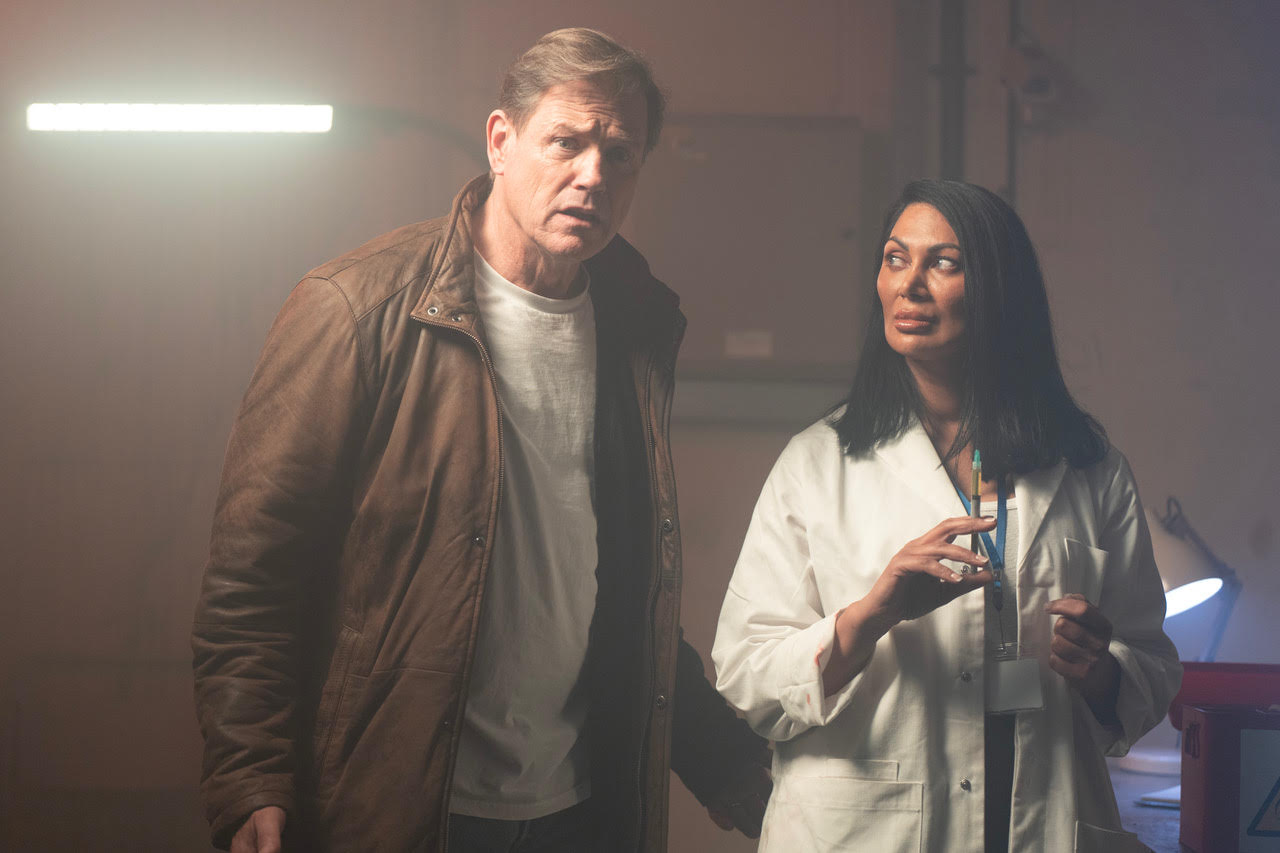
Journalist John Parker (Michael Paré) and Dr Ellen Marks (Jeanine Nerissa Sothcott) try to stop the cult of Carl Cane in Phil Claydon’s Helloween
Through the years you’ve directed the feature films Lesbian Vampire Killers which was as i recall a super fun bonkers movie that I don’t think a lot of people knew how to take (I took it as a fun crazy movie) What does your memory bring up when you think back to 2009 and its release.
Joy is the word I’d associate with the making of and subsequent release of Lesbian Vampire Killers. Although the process of getting it financed was tumultuous. Paul Hupfield and Stewart Williams wrote a very funny script that played with ridiculous Hammer tropes and base masculinity packaged in a love letter that was like an eighties American high school teen movie set inside a Hammer horror film. It was the kind of film I would have tried to get into at the cinema, and probably got turned away like I did with Gremlins and The Lost Boys (the trials of the 15 certificate in the UK) and then rented repeatedly on VHS. Originally, Paul was set to direct a micro-budget version starring his co-writer Stewart and we were working with a sales agent called AV Pictures run by industry veteran Vic Bateman (Dog Soldiers), who loved the script and wanted to get it made. In terms of getting the film over the line and financed, the package with Paul directing and Stewart starring was not working for them, and that’s when they asked if it was something I’d direct. Some difficult conversations were had, as is the way with the industry, nothing seems to happen without some kind of compromise that is painful for someone. I would later feel that myself when the script I’d written OAK was going to move forward, but I’d have to relinquish directing. The film did get up and running, but fell apart in prep, however I had cast James Corden as I was a fan of him in History Boys, he called me to talk about Matthew Horne may be right for the part of Jimmy we we get back up and running, so Ruth Jones dropped off a preview screener of Gavin and Stacey before it was aired and became massive. I watched it, loved Matt, and we got him on board. Anyway Lesbian Vampire Killers eventually happened because the newly formed Hammer films wanted to make it, and AV Pictures were concerned they were going to lose the film. And it became a situation where AV Pictures hustled harder to make the film a reality, where Hammer was still turning wheels and only offered development and no progress to production. AV Pictures set up a meeting with Momentum Pictures, that I went to on my lunch break, as at the time I was working a HGCA booking farmers onto rape seed oil conferences (filmmaking rarely pays the bills in-between so you have to have survival jobs that are usually completely unrelated to what your mission in life is). This meeting lasted about eighty minutes, and I pitched the entire film, complete with visuals and storyboards, explaining the tone, style, and how I’d approach it within a budget. At the end of the meeting – they – said they were going to come in for half the budget, Vic and Gavin were excited and off I went back to work, eventually getting a meeting with Steve Clark Hall who momentum brought on as a prodcuer and then a few weeks later got the call from Vic that it was all done. We’re good to go, and then Steve got a similar call from Xavier, he called me and said ‘better hand in your notice and come and do your proper job tomorrow’ and that’s what I did, went into the office, the boss asked when I was leaving and I said now. That day we started prep. We shot on a stage at Three Mills Studios, and walking onto the woodland set every morning was like Christmas. It really always felt amazing, even on days we were behind schedule and needed to catch up. The crew were great and top of their game, the atmosphere was creative, collaborative and fun. Post-Production was also a blast, James Herbert my editor became my best friend, the VFX team at rushes delivered on a small budget, and Debbie Wiseman’s score was beyond epic for peanuts. The film we shot was the one I set out to make in terms of look, tone and energy. And that’s the real advice I will always give about making any film, make the film you can stand by, because you never know how it’ll be recieved or enjoyed, but if you are happy with how it turned out that is all that mattered. Hence, when we got caught up in the James Corden backlash it didn’t chop my legs off or kill my spirit. I made a film that is nearly sixteen years old, and it’s still mentioned. Most films come and vanish, but Lesbian Vampire Killers is still out there, being watched, being mentioned, whether it’s a joke or a recommendation. It’s out there.
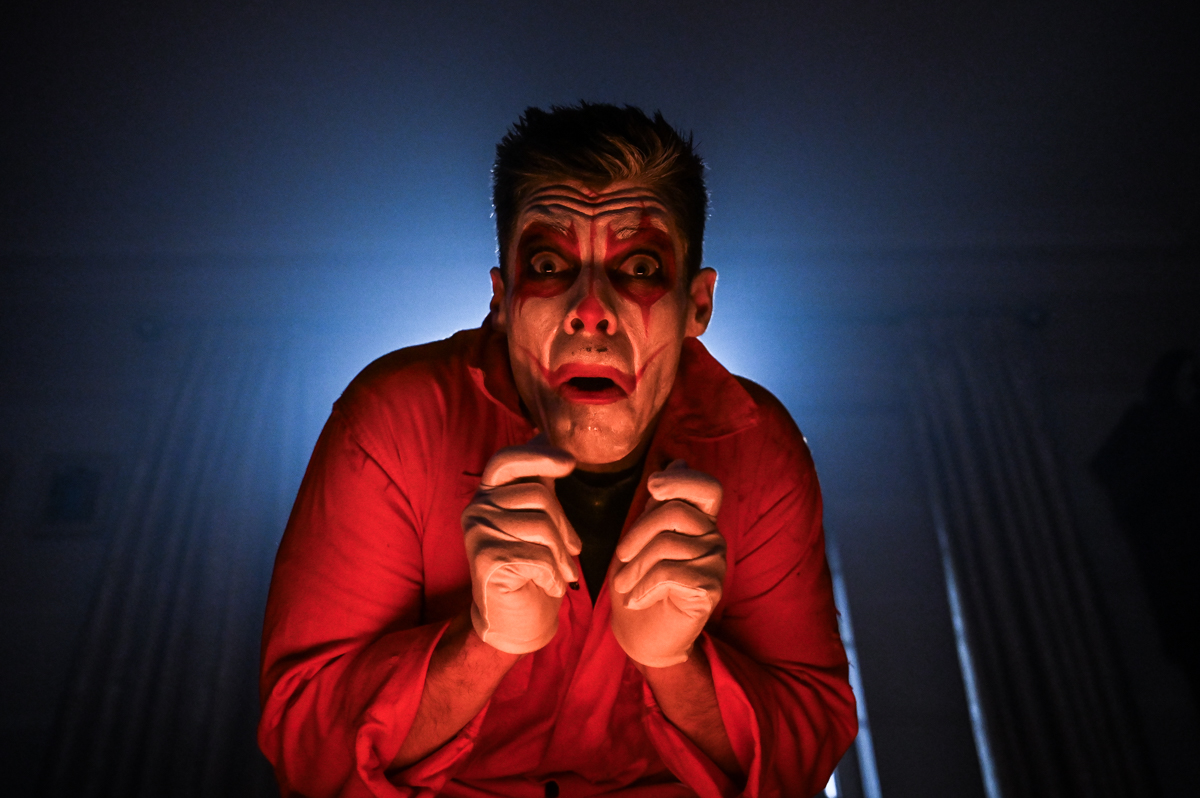
A super creepy image from Helloween
This month sees the release of Phil Claydon’s Helloween (which you wrote and directed) which does have such a love letter feel to John Carpenter’s Halloween but is also very much its own thing. A brilliant mix of such films as Terrifier, Halloween, The Purge and crazy killer clowns. How different is the finished film to the original story that you wrote?
Helloween is purely from gut instinct of what I wanted to watch. I knew I wanted an ‘impending doom’ tone for it, and create a suspenseful, taught, adrenalin shot of clown horror. I didn’t look at Terrifier and think we need to go for over the top gore, I didn’t look at IT and feel the need for supernatural terror. The pace at which the film came about didn’t require a lot of time to procrastinate. The brief from the financiers, and distributors at the time was simple: ‘a clown horror set at Halloween’. Due to the micro-budget nature of the film it needed to be two main locations. That was the brief. I immediately thought about the 2016 creepy clown sightings, and just asked the question what if there was an insidious, sinister plan behind the movement? I pitched this take to Jonathan, he loved it and left me to alone to go write a draft. If I can take any influences, it was more the attitude to making the film. I would put myself in the mind frame of early John Carpenter and Larry Cohen (hence the working title script was Maniac Clown, a homage to Maniac Cop), I would think these filmmakers had minimal resources, in terms of production and budget, but made extremely entertaining and successful movies. What Larry Cohen and John Caprenter early films have in common is with how they get you into the story very quickly, with a simple high concept and they have a tight pace. My opening is probably the closest doff of the cap to Halloween, as that movie begins with the prologue story for Michael Myers, and I wanted to start with our anatgonist Carl Cane, and make a small origin story in the opening five minutes. I knew I needed a rival, someone that can be the focus of Cane’s vengeance, which became his Doctor Ellen Marks, and we needed an investigative beat to connect Cane to the building menace of the creepy clown craze, this evolved into John Parker, who was ininitially a cop until Michael Pare was cast and I turned him into an investive journalist. The idea behind the film was to keep the main story contained while feeling like there was a bigger scarier story happening in the world around our story. My pitch pointed to The Purge, the original film, which is essentially a home invasion film (due to the small Blumhouse budgets at the time) but it alludes to a bigger threat outside. I took that model which I thought worked extrememly well and figured we can keep our film contained for the budget, and show snap shots of the threat through news, viral footage etc. Essentially you could make a few Helloween films happening on the same night with various stories being ignited by this one main event generated from Carl Cane. Helloween was written with a lot of rage which helped the process. At the time my wife and I had been in battle with the state school system and the local authority for our eldest son who had been diagnosed with autism and adhd, and as any parent of neurodiverse children know, the system and state is a place where you have to go to war for the needs of your child to get them help. The system is not set up to help, especially the school system which is designed for nuerotypical. The process is a series of tick boxes and wait lists, it is ill-equipped and you need to battle hard to get heard, get the support and make sure your child is supported rather than marginalised. I filtered that anger into Carl Cane’s rage, which is bred by the system which has failed him, he feels let down, he feels unseen, he has needs that were not met and so this spark of rage to destroy the system, and put everything and everyone on a level playing field began. Cane’s methods are obviously extreme, but I understood him while I was writing it and it made writing a character like Doctor Ellen Marks more interesting, because she is techincally the protagonist, but she works for the system, and is therefore the face of the system which Cane is fighting against. That central conflict while I was writing helped, as I could see both their points of view, and they are both right, but ultimately I believe the anarchist in us all doesn’t truly think the system is there to help us and therefore if you had to choose a side, do you side with Cane or Ellen Marks? In the current climate where people are feeling like the system has helped the few and not the many, there is unrest, and I can see how a figure like Cane could be the voice of the many and the many would join to fight against the system. We only have to look at current world leaders to realise ‘extreme’ gets listened to, and followed. It is worrying and scary times, the perfect climate to feed the themes of Helloween. I mean aren’t all horror stories born out of hidden trauma, repression or cultural unrest? I wrote Helloween (Maniac Clown) fast, from pitch to the first draft it was a three week period. I also have a full time job as s enior lecturer in film production at the University of Hertfordshire, so doing my job and carving time to write it was probably done in fourteen days. The draft was written June/July 2023 and we were green lit in August and shot for nine days in October. It was an extremely fast turnaround from script to screen. Being writer, director and editor, the film did not very much from what was written. The tone, intensity, pace of the film remained. Only small changes happened due to casting, budget and location. John Parker was originally a British detective who made the original arrest of Carl Cane and is investigating the creepy clown uprising and the incarcerated Cane. When the acting legend Michael Pare was cast, I changed the role to an investigative journalist who interviewed Carl Cane for his documentary. This actually worked better for the film. There was a different scare piece in the end sequence set in the morgue of the hospital, and had bodies under sheets on gurneys. However this was going to be expensive. What you never want to do is try and make something work with very little money and have it looking inffective. These are decisions I make as director, you have to work with what you have, if you try and stretch beyond what is possible the visual world can come appart at the seems. This informed my approach to the gore and kill scenes. We did not have the schedule or budget for prosphetics, and elaborate gore effects, this informed my approach which leaned into Psycho, Halloween, Texas Chainsaw Massacre, they are bloodless films, and the kills, gore is all implied with, editing sound and compositon. This has to be the intention of approach and design of the film from the start. A lot of the time it is what the audience doesn’t see that can be more impactful; you leave their imagination to fill in the blanks. Although one day I’d love to do something gory and squishy, the parameters of this film did not allow for that. The original ending was slightly different, as it involved a group of Cane Clown followers surrounding Ellen and her daughter Leah. However, again this is a budget question, it was not going to be possible to get extras, make-ups and the time to shoot a sequence like that. Limitations are not comporomises, they just make you more creative and usually you make the irght choice for the film. The final version of Helloween is very much the movie I had in my head while writing, yes htings change due to time, budget, casting etc but it is the same result as I felt with Lesbian Vampire Killers, and Alone, the final film is the one that was intended from conception. A side note about my experience in the industry for nearly twenty five years, you you end up the making the film you get to make rather than the film you want to make. By that I don’t mean you don’t want to make the film you end up doing, you fall in love creatively with any project. The fact is that project usually comes about for me by pushing some other project that I’ve written, and through that you make connections and relationships that lead to other opportunities already in motion. I still want to make my teen sci fi comedy horror LUST, I still want to make Zombie Island, with The Running Man coming out there may be a thirst for that in the market. I still want to make my teen horror REBEL RIDING HOOD. One day I’ll make them, and doing a micro-budget film has opened my eyes to what I could potentially do with less, not saying I can make these for 60k but I could make them for a smaller budget than I first believed I would need.
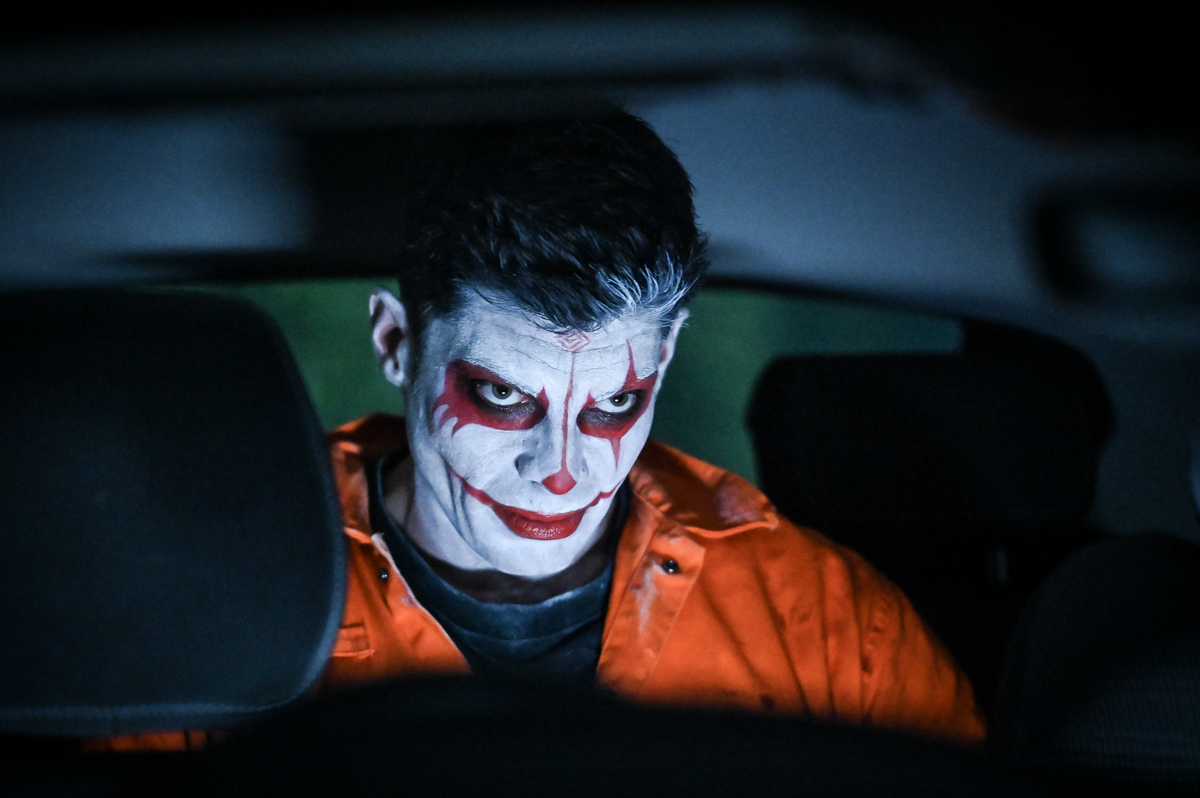
Meet Carl Cane (played by Ronan Summers)
Who was the first person to read a finished draft of Helloween?
What do you recall about the real killer clown phenomenon from a few years ago and did you ever see one of these mad clowns?
I only remembered it as a passing news item, appearing in tabloid papers and as segments at either the end of the news, or something on daytime TV like This Morning. I thought it was some kind of viral promotion for New Line Cinema’s IT. The whole thing seemed weird as it was happening in like summer time, but then increased towards Halloween. As a horror fan I had a curiosity about it, clowns have never scared me as much as they do a lot of people. I never encountered a clown during that period, and even if I did it probably wouldn’t have freaked me out that much. The original Pennywise in the TV series IT was scary, as was the clown puppet in Poltergeist. But someone like the Child Catcher in Chitty Chitty Bang Bang that was pure terror fuel for me. Question Post-Production, you are editor on the film how did post-Production unfold, how did you find cutting your own film? Thematically the clown works for Helloween, Carl Cane is forced to wear a mask, an alter ego to operate in the world. Neurodiverse people spend their lives masking, so the idea of clown make-up to mask became a solid theme and visual representation for the film.
The film (Helloween) looks visually stunning (cinematography by James Westlake) what discussions went on before filming to decide the ‘look’ of the film? And were there any other films that you used as references to what you wanted for your vision.
James Westlake was awesome to work with. He just got what I was going for. Darkness and colour was a prevailing theme. And a healthy dose of haze. I had done various mood boards to capture the vibe of the film, and when James was recommended by Jonathan, the first thing he did was send across his mood and lighting boards for each location. Without us even talking and him reading the script, a lot of our chosen visuals were the same. So when we went to talk about potentially shooting the film we were on the same page. We went through many references everything from Talk to Me, Bodies Bodies Bodies, It Follows. We were searching for mood and vibe, but also you are balancing that with time. We would have no time, so I needed to be drilled down with the shots I needed, James’ camera team (small and superb by the way shouts out to Andy Fiamanya, Lewis Thompson and Julian Hundy) needed to be drilled with how to execute it, light it, grip it. We had more moving camera, dolly, gimbal etc than you’d expect to see on this kind of budget. They moved fast. Each set up was ten to twenty minutes, and we kept going, a lot of time trying to weave in a B camera also, to get as many great shots for the scenes as possible. With a clear plan in prep it makes it all the more easier on set, and with storyboards, floor plans, and a plan for every scene we were very efficient. Most times we were waiting on elements like props, or actors etc. Or we were waiting to get the room hazed up with smoke. I’d say Helloween is slightly more saturated with colour than most horror, James lighting worked in the grade brilliantly to be dark and colourful. A well crafted film visually and I expect James to move onto bigger budget films where he can play.

Carl Cane lurks.
What was the most challenging scene to film?
Every scene simply because we had 9 days to shoot it in. Which meant we had to shoot nine pages a day, and every day included some major story beat or set piece like a kill scene, jump scare or major sequence of suspense. In order to craft suspense you need the shots, and in order to get the shots, you need time. And we were always against time. Luckily James and his team moved quick, so for example on Lesbian Vampire Killers and Within each new set up would take 30 mins to an hour. Whereas on this we would usually be 10 to 15 mins, sometimes less, depending on lighting. Sometimes the camera team were so quick we were waiting for the hazer to haze the room up. I love haze, so important for texture in a space in horror. I’d sometimes turn it on but then get distracted and leave it running, then we’d be waiting for the haze to clear as we had too much. Which became a running joke as we knew if there was too much smoke I was the one who had probably turned it on. Everything is about being as planned as you can be, that’s why I storyboard everything. I spend as much time sketching thumbnail shots and ideas for sequences until I feel a certain combination of shots will get the effect I need to make the scene work. I also have the ability to adapt if we are running out of time, and we need to make a scene work with less, I have an editors brain so I can quickly edit a scene in my head and it will quickly tell me what I need to make a scene work. I edited Helloween and I only had to grab two pick up insert shots, which were done DIY by myself and wife in my garage and kitchen. True indie filmmaking.
Lets talk Post Production?
Production is the smallest part of this film, a short prep time, a short shoot of nine days. Post-production took about eighteen months. After trying to get an editor on board, which is difficult when you have no budget to offer, I had to step in and edit the film. I can edit obviously, but never cut a feature before, and also never cut on AVID before. I wanted to cut on AVID as all my editor friends use it and if I ran into post trouble I knew where to turn for help. It was a steep learning curve, at one point I talked to friend James Herbert about what I was doing, as I had to get the fim we shot into AVID, synch the rushes with sound etc and I got stuck at one point, talked to my friend and he was like, you’re doing all that yourself. Usually a lab takes care of dailies, transcoding (making the footage into a sizable amount to edit with) an assistant editor takes care of synching and the editor then cuts. But I was doing all the tech work just to get the footage ready to actually cut. I got a vertical learning curve in post-production, it is still my favourite part of the filmmaking process. But having done post nearly entirely myself, I have nothing but respect for everyone involved in post. From post supervisors, to assistant editors, to labs, to music editors, to vfx editors graphics editors, the entire team of people it usually takes to craft a film in post, it was all on me. I managed to start cutting late November, had an assembly in January and delivered the directors cut in May 2024. However due to the nature of the film, there was still masses to do. The idea of the film was it’s set in 2016 during the creepy clown viral video craze, and a lot of this information and world building was being done through news reports on TV. Those news reports needed to be shot, the viral videos of the clowns needed to be shot. And all those elements would need news graphics, VFX composites to replace green screen when shooting the news readers. Once we had managed to grab all that footage, I still had to create the VFX for the film, now I know we are not Jurassic Park, but we had to put media on blank tv screens, cctv screens, and all that media needed to be built and designed, and then composited. I had about forty VFX shots to composite myself. But when those were done they still needed to cut into the film, and the opening titles still needed to be cut, which was a gargantuan task. The opening titles are two minutes long, one half is John Parkers documentary about Carl Cane ‘Why Kids Kill’. And then it skips to 2016 with loads of news reports about the rising creepy clown menace. Every piece of footage needed shooting, graphics designed, crime scene photos mocked up and shot. It was an epic task. For some of the news graphics I managed to rope in my brother in laws wife Kajsa, who knew after effects and could do some motion graphics, and moving maps. I had to design the title art for the film, and then design credits. The list of jobs goes on, but post was epic just to get picture complete. Of course when it is complete – it still needed a grade and colouring. Luckily my work colleague, James Gregory, at the University of Hertfordshire is a colourist and understands how to get to deliver the picture. We took about four days to colour the film, and then had a few more sessions once I’d completed the VFX shots. Picture was complete but we still needed music and sound… yep with horror sound is seventy percent of the film, I know most say 50/50 with picture and sound, but really and truly you think horror, you actually hear horror, that’s why it’s scary.
And lets chat about the Sound and Music
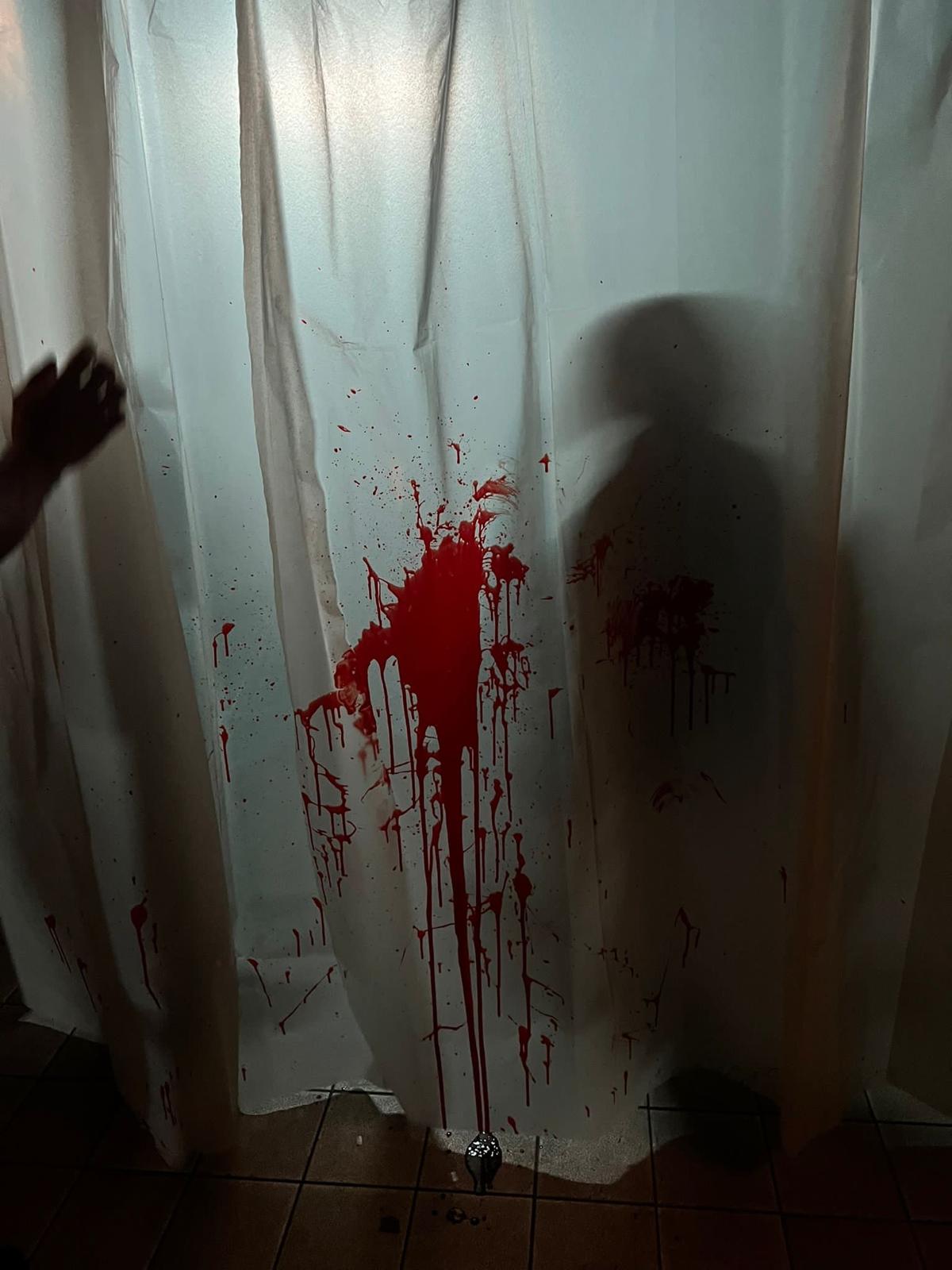
The scene of a crime!
Do you have any ‘props or keepsakes from any of your films?
have one of Alex’s watches that they wear from Alone (it’s packed away and reminds me I need to mount that and get it on display). I also have the Sword of Daeldo from Lesbian Vampire Killers, it was forged with Baron Wolfgang McClaren’s own blood and infused with a Babylonian hex, or the legend goes. But just in case Carmilla the Vampire Queen resurrects again, I have that sword, which is the only weapon that can defeat her. Helloween, I have the box of props and Carl Cane’s costume, mainly because I was driving the box of props around with me in my car while shooting. I also sourced and designed Cane’s costume. Trinity, my daughter and myself did all the distressed by spraying coffee on it, and rubbing it against the bricks of the house. Inside that prop box is also Cane’s bloody shiv, foam axes, and the sweets Cane uses as trails in the film (I wouldn’t eat those now!)
What is one film that gives you the ‘creeps’? Or scares you
I don’t really have one film that creeps me out. Growing up the one thing that scared the life out of me was the Child Catcher from Chitty Chitty Bang Bang, just the thought of watching that film gave me immense anxiety. In terms of design, casting, costume and performance, that thing is utterly terrifying and nothing really came close in creating a sense of dread inside me. Even going on to watch horror films at a very young age, the terror factor had to be high to compete with the Child Catcher. If you want to know films that have affected me so much that I have not watched again, it’d be Eden Lake (left me shaken for days), Martyrs (left me numb) and The Elephant Man (too damn upsetting).
If you had to make a ‘bucket list’ of people you’d love to work with, tell me one name who would be on it?
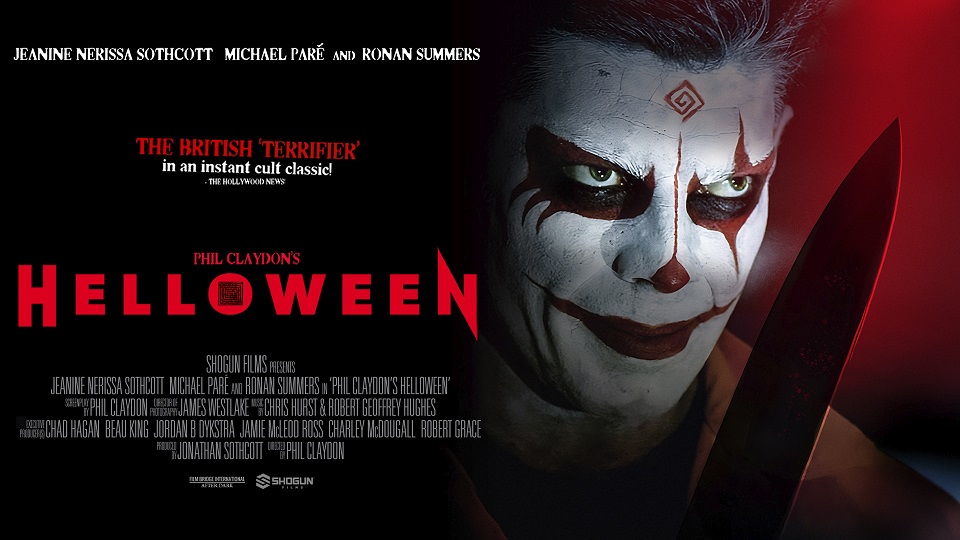
Helloween is out now on Digital in the USA, and will be released digitally in the UK from September 29th, and released on UK Bluray from October 13th


 frompage2screen.com