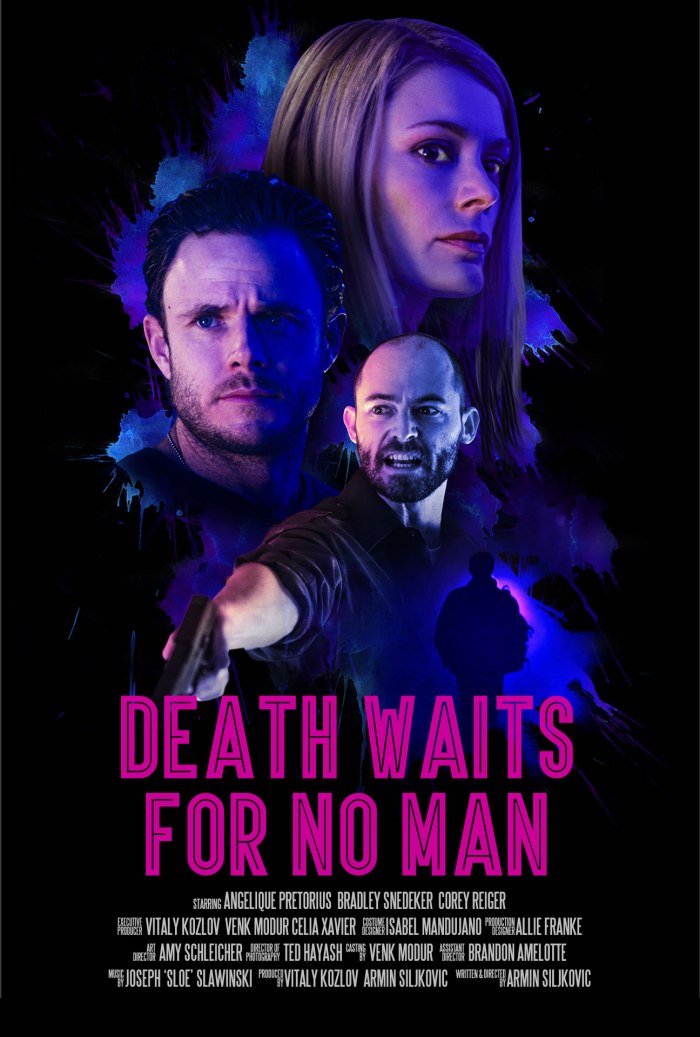
The Postman Always Rings Twice meets Drive in writer-director Armin Siljkovic’s neon-doused indie noir-thriller Death Waits for No Man.
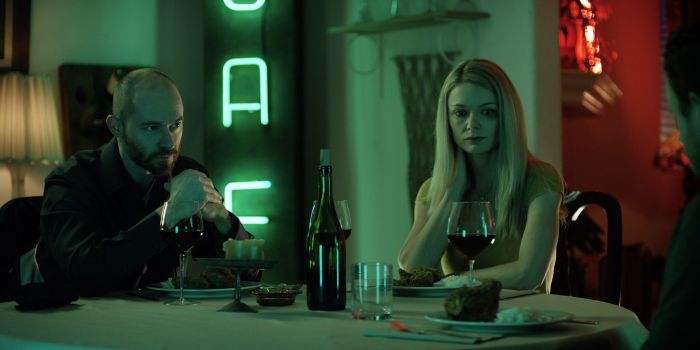
Expected to release late 2017/early 2018, it’s the unnerving and complex chronicle of a neon art collector that seduces a lone drifter into killing her abusive husband.
Black Sails’ Angelique Pretorius headlines a cast that includes Bradley Snedeker, Corey Rieger and Travis Myers.
“Death Waits for No Man” is released this Fall.
I always enjoy not only asking filmmakers and creative people questions about their career, but more than that. I love reading their answers and learning more about their creative process which in turn helps mine to grow. I was fortunate enough to be able to get these great answers from filmmaker Armin Siljkovic and as much as I enjoyed them. Im sure you will to. Many thanks to Clint Morris at October Coast

Do you recall when you sat down to write the film – and why?
I don’t recall the specific moment, it’s a long process for me. It starts with an idea, maybe a few sentences written down, and then it morphs and takes shape over the course of the year or so it takes to write (an rewrite) a script.
Did you sit down and watch a bunch of similar themed movies as inspiration before or during the script-writing process?
I’ve always been a fan of film noirs so I re-watched some of them, just to get into the mood.
How many drafts did you go through?
About 15 or so.
What did you lose along the way?
Rewriting is interesting, you add things, you remove things, you tighten certain areas and so on. But once the film gets into production, rewriting takes on a new meaning. Because you are now thinking practically, and sometimes, you might not have a location that you wanted, or you might not have enough money to film something. So you end up cutting or combining scenes. Then during rehearsals, you tweak aspects of the script and dialogue. It’s one thing to write it down, it’s another thing to actually hear the words read by the actors.
Did you write with a budget in mind – and therefore tried not to write in ‘too many’ huge explosions and costly stunts?
For this project, yes. I wanted to write a noir thriller that I could realistically film and not spend years trying to find funding for. Which is especially important since it’s my first film and it’s tough to get someone to give you a lot of money when you’re an unproven filmmaker.
How much of the movie simply happened ‘on the set’?
Very little, actually. We prepared extensively, I rehearsed with the actors etc. It was important to be prepared because we had very limited time to shoot the movie, so everything needed to be in place. But as with all film productions, you have those awesome little moments that just happen on the day that you never planned for.
Why did you decide on your cast?
Death Waits For No Man was a tough film to cast because of its risky and controversial material. Anytime you have a film like that, it’s really important to cast it well and that the actors pull it off. Which I think they did – we had a terrific cast of actors.
Is a movie like this only as good as its villain? Do you believe an interesting bad guy is as important as a compelling hero?
Of course. The stronger the villain, the stronger the hero has to be to beat him, which ultiamtely means more drama and tension. It’s even better when the audience can understand the reasons why the villain is doing what he’s doing. They might not agree or condone his/her actions, but it’s important for me the that the audience understands where the villain is coming from.
Tell us what makes your bad guy tick.
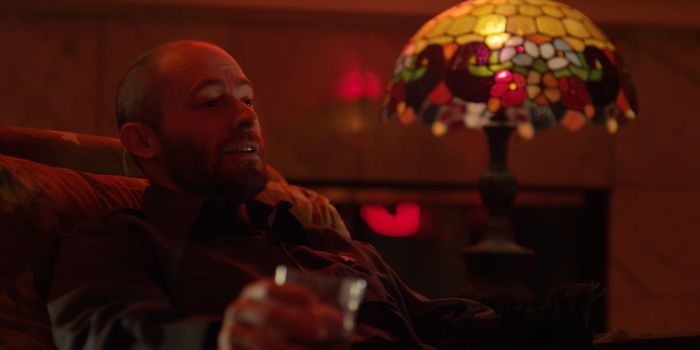
I’d say for the most part, he’s just a guy caught in a situation that went too far, to a point where there is no going back for him. And that’s something he has to deal. He’s a war veteran who longs for the war he was in, where the “normal” world is just too mundane for him.
How much was Adrian Lyne an influence on the movies. He thrived on doing films like this – and they were brilliant.
I wouldn’t say his films had much of an influence, Death Waits For No Man is tonally and visually different, but Lyne was a master of telling edgy, controversial stories, I think we need more filmmakers like him.
Who are some of your favorite screenwriters?
Off the top of my head: David Mamet, John Milius, Rod Serling, and the Coen brothers.


 frompage2screen.com